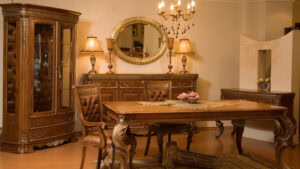
For furniture importers, technology adds value only when it makes a classic design easier to repeat without flattening its proportions. The practical question is which operations need controlled repeatability and which still need skilled visual judgment.
At Hoolnn, we use CNC machining where repeatable dimensions and structural accuracy matter most, while retaining wood turning, hand-finishing, and detailed inspection for the proportions and surface character that define classic solid wood furniture.
Precision Supports Craft; It Does Not Replace It
Classic furniture often appears simple only after the details have been resolved. A dining table with a shaped trestle base, a turned leg, or a carved transition between components depends on more than attractive wood. It also depends on accurate joints, stable dimensions, and consistent assembly.
CNC is a control method rather than a different style of woodworking. After a drawing and component profile are approved, a programmed toolpath can repeat cutting, drilling, slotting, profiling, and component positioning. This is most useful when the same structural features must be reproduced across a bulk order.
Traditional turning relies on an operator guiding the cutting tool at the lathe; CNC turning follows a programmed cutting path after setup. Manual turning can suit one-off development and adjustments, while CNC turning is valuable for approved legs, posts, or pedestal parts that must repeat. In either route, sanding, proportion checks, and finish assessment remain essential.
| Manufacturing method | Best suited to | What buyers should approve |
| CNC machining | Repeated dimensions, drilling, slotting, joinery preparation, and profile cutting | Drawing dimensions, hole and joint positions, and the repeatable profile |
| CNC wood turning | Approved turned legs, posts, balusters, and pedestal components in repeat orders | Overall length, key diameters, transition points, and sample appearance |
| Traditional / hand turning | Early development, small quantities, simple pieces, or visually adjusted details | The finished silhouette, proportion, and any acceptable handcrafted variation |
| Hand finishing and QC | Sanding, edge refinement, distressing, touch-up, assembly, and packing checks | Surface feel, finish range, stability, visible detail, and packing condition |
The strongest result comes from using each process where it adds the most value.
Where CNC Machining Improves Furniture Production
In solid wood furniture, a small difference in a drilled hole, mortise, or repeated profile can affect later assembly. A digital program helps control the cutting path, but it does not eliminate the need to check timber quality, tool condition, or the finished surface.
We use CNC machining to create a reliable basis for repeatable stages. For buyers, the benefit is not technology for its own sake: it is a clearer route from an approved drawing and sample to components that can be assembled consistently at scale.
CNC-supported operations can help us:
- Keep key component dimensions aligned with approved drawings or samples;
- Prepare consistent drilling, mortise, groove, and fixing locations;
- Improve the repeatability of structural parts across an order;
- Reduce dependence on repeated manual measurement for identical components;
- Support a clearer transition from sample confirmation to bulk production.
CNC machining controls geometry; it does not remove the natural variation of solid wood. Grain, colour, and texture still need an agreed acceptance range. The purpose of CNC is to keep the structural framework controlled so natural variation reads as material character rather than poor consistency.

Why Wood Turning Still Matters in Classic Furniture
Certain furniture details cannot be reduced to a flat profile or a simple straight cut. Turned legs, pedestal forms, rounded posts, and curved transitions influence the visual balance of a piece from every angle.
Wood turning gives these elements their depth. A successful turned component must have the right relationship between its widest and narrowest points, its shoulder transitions, and its connection to the rail, stretcher, or base. In traditional furniture, a slight change in proportion can make a table feel heavier, flatter, or less refined.
We use wood turning where the design calls for three-dimensional form and classical detail. For a repeat order, the profile should be defined by clear reference points: overall length, maximum and minimum diameters, shoulder transitions, and the connection to the rail, stretcher, or base.
The process can be applied to elements such as:
- Baluster and pedestal table supports;
- Turned dining-table legs;
- Tapered or fluted chair legs;
- Rounded posts and decorative feet;
- Symmetrical components within traditional furniture collections.
For buyers, the silhouette is often the most recognisable part of a classic design. That is why a turned profile should be approved as both a measured component and a finished visual reference before bulk production.
Our Oak Wood Dining Table illustrates this relationship. The product combines an oak tabletop with a substantial trestle base and hand-carved details. Its proportions, moulded tabletop edge, shaped supports, and base construction need to work together as a complete design—not as individually acceptable parts.

From Drawing to Bulk Production: A Controlled Workflow
For an importer, manufacturing capability matters only when it creates a more predictable development process. CNC machining and wood turning are therefore part of a wider workflow from buyer brief and feasibility review to sample approval and finished-goods inspection.
| Project stage | Decision to freeze | Why it matters in production |
| Design review | Dimensions, material, structure, style references, target quantity | Identifies which operations should be repeatable and which details need visual craft review. |
| Sample development | Profile reference points, connections, finish, and visual balance | Tests whether the selected CNC, turning, and finishing route produces the intended result. |
| Pre-production approval | Approved sample, technical requirements, and change records | Creates the reference for programming, setup, and bulk inspection. |
| Bulk manufacturing | Controlled dimensions and approved component profiles | Supports repeatability while retaining checks for timber variation and finished appearance. |
| Final inspection | Assembly, stability, finish, visible detail, and packing condition | Confirms the finished product against the agreed sample and requirements. |
Programming and setup should be considered early. A detailed profile repeated across a larger order may justify a programmed CNC route, while early prototypes, small quantities, or evolving artistic details may be better reviewed with more manual input. The appropriate route depends on profile complexity, quantity, and what the approved sample has frozen.
Efficiency Should Not Flatten the Design
Production efficiency is often misunderstood as a trade-off against classic character. In practice, the right use of technology can protect the very details that buyers want to preserve.
For example, CNC machining can prepare accurate joints and fixing positions before a shaped leg or trestle base is assembled. Our craftspeople can then focus on visual checks: the curve of a turned support, the smoothness of a transition, the alignment of a moulded edge, and the way a finish responds to the grain.
A machined component may still require sanding, edge softening, hand-finishing, or controlled distressing before it matches an approved antique or French-country appearance. Machining accuracy and finished character must be checked as separate acceptance points.
We do not treat machinery as a substitute for craftsmanship. We use it to make repeatable work more controlled, allowing experienced makers to focus on the details that are difficult to standardise with a purely automated process.
What Importers Should Confirm Before Production
When developing a furniture program with turned or classical wood details, buyers should confirm more than overall dimensions and finish colour. The profile, reference points, connection details, acceptable timber variation, and quantity all influence the most practical production route.
| Area to confirm | Questions to discuss with the supplier |
| Profile definition | Are overall length, key diameters, taper, shoulder transitions, and visible details identified on the drawing or approved sample? |
| Production route | Which parts need programmed repeatability, and which details require manual turning or hand-finishing? |
| Structural connections | Are tenons, drilling, hardware, rails, stretchers, and fixing positions clear before machining begins? |
| Material and finish | Which wood characteristics, stain range, sheen, texture, and natural variation are acceptable? |
| Batch consistency | Which visible components require closer matching, and which sample or records govern replenishment orders? |
| Packaging | Are turned legs, moulded edges, and trestle components protected against rubbing, pressure, and movement in transit? |
These discussions are especially important for coordinated collections. A dining table, sideboard, chair, or occasional table may share a finish language but require different machining, turning, and assembly controls. Defining the non-negotiable visual and structural details helps us select the appropriate route for each item.
Hoolnn: Precision for Classic Furniture
At Hoolnn, we use CNC machining to control repeatable profiles, hole positions, and component dimensions, while wood turning shapes legs, posts, and pedestal details. Sanding, finishing, and inspection are checked against the approved sample.
For each project, we review key dimensions, timber and finish selection, profile reference points, joint or hardware positions, target quantity, and packing needs. Send us your drawings, reference images, and specifications before sampling so we can confirm the production approach and critical approval points, contact us to discuss your project.